For solo founders, indie hackers, and working professionals
Discover a business idea for your background, grounded in real market research
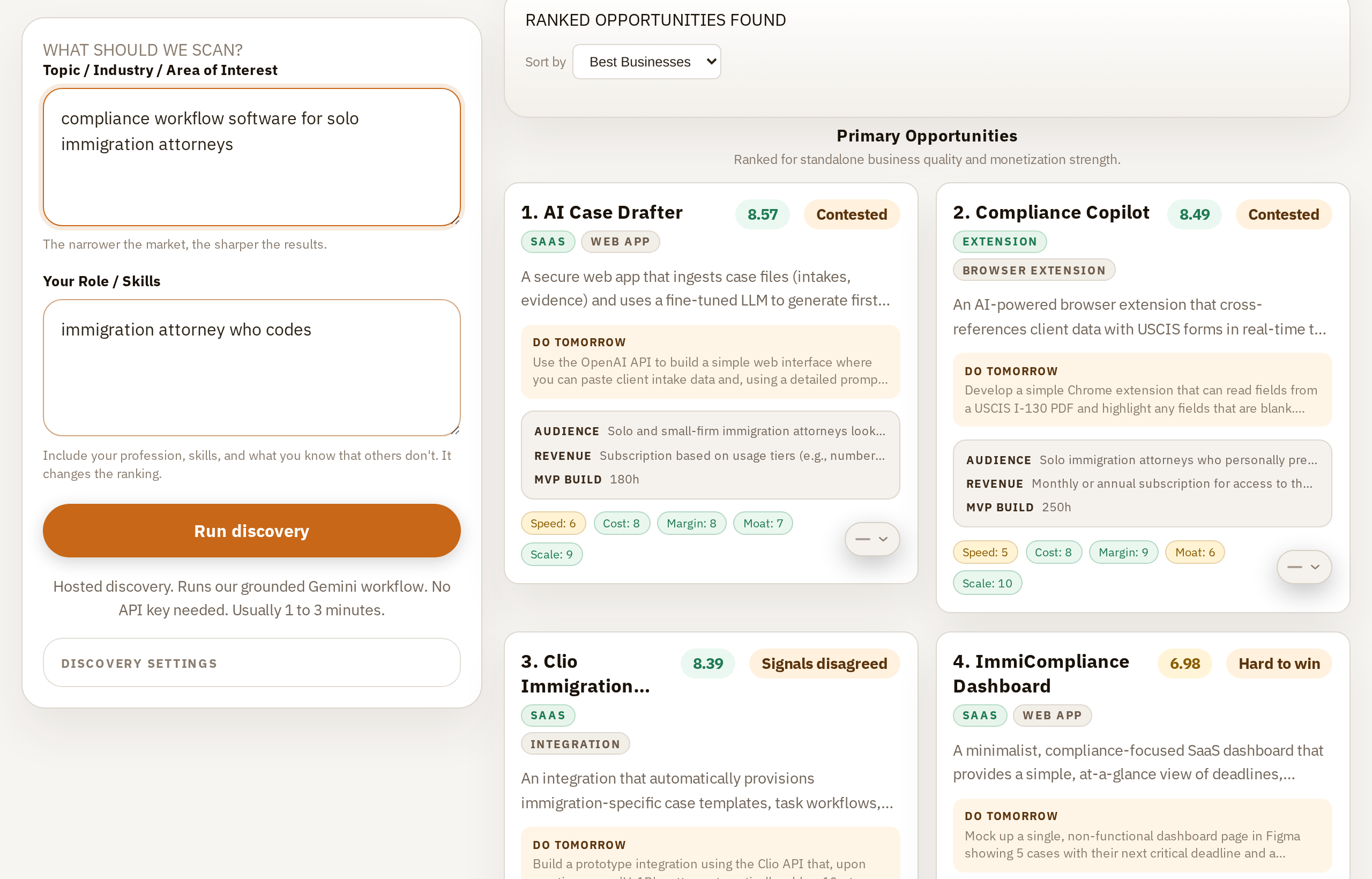
Describe the field you know and what you're good at. Get back ranked opportunities with named competitors, real pricing anchors, and a literal next step you could take this week.
Free to start: sign in and your 1st free trial scan is on us. Want to see the output first? Read five complete scans, published unedited. Built by an ex-Thomson Reuters engineer who became a licensed attorney.
Curated Examples
Find ideas for your profession
Monthly Product Ideas
September 2026: a fresh batch of 371 product ideas across 26 markets, mined from open sources.
We have hundreds of good reviews. Last week we got a one-star... A hundred kind reviews I have not reread in months, and this one bad one lives in my head rent free.
We audit our own tool. Same 25 ideas, scored twice: rank correlation −0.05. We published the number and demoted the score. Read the full audit →
Updates
Published the first monthly edition: 371 product ideas across 26 professional markets, each one quoted from the public thread it came from. Browse the edition
Scans now answer in the language you write in, down to the competitor research.
Briefs now adapt to what an idea actually is: software gets a build plan, a service gets a launch plan.
We audited our own winnability score and published the result: rank correlation of −0.05 between identical runs. The display was rebuilt around repeat checks. Read the audit
Competitor price claims are now checked against the research evidence before results are saved.
Frequently asked questions
Most of these came from builders responding to our Indie Hackers launch post.
How is this different from an AI idea generator?
Idea generators produce lists. This researches a specific market with live web search, scores each direction on business quality and operator fit, and returns ranked results with evidence. What is the difference between an idea generator and a discovery platform →
What makes a good scan input?
Specifics. A niche beats an industry: "billing software for private music teachers" returns sharper results than "software". Same for your background: "paralegal for 10 years, learning to code" gives the ranking something to work with, while "developer" gets generic ideas. The narrower the market and the realer the profile, the better the output.
Can I use it in my own language?
Yes. Write your topic and background in your language and the results come back in it, down to the competitor research: a Russian scan surfaced Russian competitors with ruble pricing, not translations of American tools.
Isn't the scoring just pessimistic?
Skeptical by default is deliberate: an idea has to show a paid price floor and a real market gap to rank high. And we test our own calibration instead of guessing. When a blind test showed our winnability score agreeing with itself at a rank correlation of −0.05, we stopped displaying decimals and rebuilt the display around repeat checks. Read the full audit →
What separates the ideas that score high?
Willingness to pay, more than anything. High-scoring ideas sit in markets with an established paid price floor, often $30 to $100 a month, where the validated competitor list shows real companies charging real money.
What if an idea scores low but fits me perfectly?
A low score is not a kill order. The scores measure market conditions; they cannot see your network, your credentials, or your access to the audience. Unusual distribution can outweigh a crowded market. What operator fit means →
Have you scored products that already succeeded?
Yes. Known bootstrapped winners scored between 1.0 and 5.9 when we ran them through the scanner. That is a real limit worth knowing: the scanner sees today's competitive landscape, not the emptier one those founders entered years ago. It evaluates conditions now, which is what matters for an idea you would start now.
Does it account for my specific skills?
Your role shapes what gets generated: a nurse gets healthcare plays, an attorney gets legal-ops, and regulated professions get their compliance friction flagged. The current limit is build estimates, which assume a solo developer starting from scratch.